The last decade has been a thrilling and eventful ride for the field of artificial intelligence (AI). Modest explorations of the potential of deep learning turned into an explosive proliferation of a field that now includes everything from recommender systems in e-commerce to object detection for autonomous vehicles and generative models that can create everything from realistic images to coherent text.
In this article, we’ll take a walk down memory lane and revisit some of the key breakthroughs that got us to where we are today. Whether you are a seasoned AI practitioner or simply interested in the latest developments in the field, this article will provide you with a comprehensive overview of the remarkable progress that led AI to become a household name.
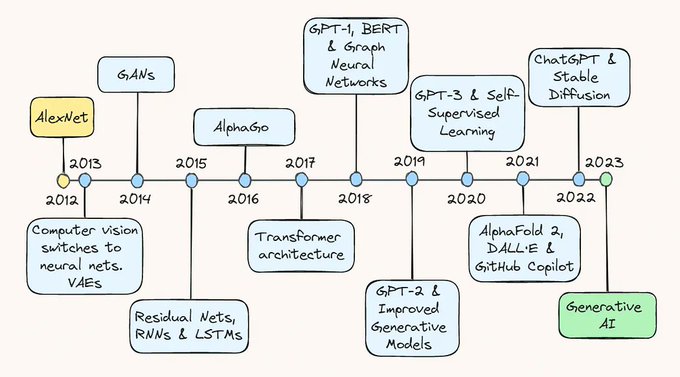
2013: AlexNet and Variational Autoencoders
The year 2013 is widely regarded as the “coming-of-age” of deep learning, initiated by major advances in computer vision. According to a recent interview of Geoffrey Hinton, by 2013 “pretty much all the computer vision research had switched to neural nets”. This boom was primarily fueled by a rather surprising breakthrough in image recognition one year earlier.
In September 2012, AlexNet, a deep convolutional neural network (CNN), pulled off a record-breaking performance in the ImageNet Large Scale Visual Recognition Challenge (ILSVRC), demonstrating the potential of deep learning for image recognition tasks. It achieved a top-5 error of 15.3%, which was 10.9% lower than that of its nearest competitor.
Mots-clés : cybersécurité, sécurité informatique, protection des données, menaces cybernétiques, veille cyber, analyse de vulnérabilités, sécurité des réseaux, cyberattaques, conformité RGPD, NIS2, DORA, PCIDSS, DEVSECOPS, eSANTE, intelligence artificielle, IA en cybersécurité, apprentissage automatique, deep learning, algorithmes de sécurité, détection des anomalies, systèmes intelligents, automatisation de la sécurité, IA pour la prévention des cyberattaques.